
Expressivism
When I began teaching at the University of Maryland, I began to think more seriously about the family of metaethical theories known as noncognitivism, and particularly about the more influential contemporary such theory, known as expressivism.
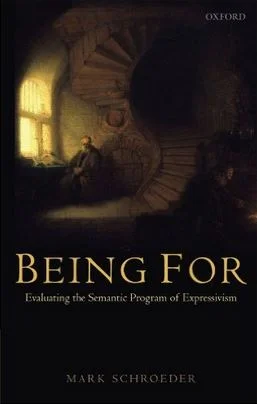
This work led to my second and third books, Being For (Oxford 2008) and Noncognitivism in Ethics (Routledge 2010, 2nd edition 2022) and the papers collected in my second volume of papers, Expressing Our Attitudes (Oxford 2015), as well as papers honored with the APA Article Prize for the best paper published in all of philosophy in 2008 or 2009, and three selections for the Philosophers’ Annual, for papers honored as among the best ten papers published in all of philosophy in 2008, 2009, and 2011. Noncognitivism in Ethics is an introductory treatment of the issues surrounding expressivism and similar views in metaethics, while Being For is a sustained treatment of the Frege-Geach problem and development of an initially promising way of addressing it together with an assessment of its ultimate limitations.
This strand of my research also led to thinking about the nature of linguistic meaning and about truth, conditionals, and epistemic possibility. The main argumentative line of Being For is to constructively develop a positive expressivist theory and then to draw out its limitations.
Since writing Being For I have been concerned with the classification and evaluation of alternative more promising forms of expressivist theory, with applications of expressivism to conditionals, epistemic modals, and especially for the purposes of giving paradox-resistant accounts of truth, and with the comparative merits of expressivism, contextualism, and relativism for similar applications. A recent representative of this strand of my research is my paper ‘Getting Perspective on Objective Reasons’, published in 2017 in Ethics.
Expressivism - General
-
‘Expression for Expressivists.’ Philosophy and Phenomenological Research 76(1): 86-116, January 2008. (Reprinted in Expressing Our Attitudes.)
In this paper I consider what account of the expressing relation is compatible with making good on the core commitments of expressivism, argue against several possible answers, and defend my own answer, on which expressivism amounts to a kind of assertability-conditional semantics.
-
‘Does Expressivism Have Subjectivist Consequences?’ Philosophical Perspectives 28 (Ethics): 278-290, December 2014.
Many philosophers have had the nagging suspicion that metaethical expressivism is committed to a kind of subjectivism about morality - that it in some way varies with or depends on our own attitudes. This paper gives detailed responses to three of the most sophisticated attempts to make good on this suspicion, arguing that all three fail, and fail for the same reason.
-
‘How Not to Avoid Wishful Thinking.’ In New Waves in Metaethics, edited by Michael Brady, 126-140. New York: Palgrave MacMillan, January 2011.
Cian Dorr's Wishful Thinking problem for noncognitivism charges noncognitivists with facing a dilemma between licensing ways of forming beliefs about matters of empirical fact that resemble wishful thinking or else failing to make sense of many cases of rational inference. In this paper I survey and collect problems for two resourceful attempts to evade this problem.
-
'Convergence in Plan.' In Meaning, Decision, and Norms: Themes from the Philosophy of Allan Gibbard, edited by Billy Dunaway and David Plunkett, Maize Books, 307-318, July 2022.
One of the central virtues of expressivism is often taken to be that it allows us to make sense of reasonable but informed disagreements, because nothing about the meanings of terms given an expressivist treatment guarantees that one answer is better than another. Yet expressivism is sometimes applied to topics where the range of reasonable or expected disagreement is very small. This paper takes a first rough stab at exploring what resources expressivists have for to explain varying degrees of convergence, as Allan Gibbard would put it, 'in plan'.
-
‘Expressivism and Moral Disagreement.’ With Christa Peterson. Forthcoming in the Routledge Handbook of Philosophy of Disagreement, to be edited by Maria Baghramian, Adam Carter, and Rach Rowland.
On Being For
-
‘Synopsis of Being For.’ Analysis Reviews 70(1): 101-104, January 2010.
This is a synopsis of the main contributions and theses of Being For for a symposium published in Analysis Reviews with contributions from Ralph Wedgwood and Andrew Alwood.
-
‘Getting Noncognitivism Out of the ’Woods.’ Analysis Reviews 70(1): 129-139, January 2010.
This is my response to the critical discussions of Being For in the Analysis Reviews symposium published in 2010.
-
‘Skorupski on Being For.’ Analysis 72(4): 735-739, October 2012.
John Skorupski published an objection to my solution to the negation problem for expressivism in Analysis. This short article is my reply.
Hybrid Expressivism
-
‘Hybrid Expressivism: Virtues and Vices.’ Ethics 119(2): 257-309, March 2009. Reprinted in Expressing Our Attitudes.
This paper offers a comprehensive treatment of the advantages and disadvantages of “hybrid” metaethical theories and argues that the advantages of hybrid theories are real and interesting but subtle rather than dramatic.
-
‘Tempered Expressivism.’ Oxford Studies in Metaethics 8: 283-314, July 2013. Reprinted in Expressing Our Attitudes.
This paper was one of two published in the same issue of Oxford Studies in Metaethics to introduce the idea of relational expressivism, a kind of generalization on hybrid expressivism that is more congenial to metaethical irrealism and can solve more of the traditional problems for metaethical expressivism.
-
‘The Truth in Hybrid Semantics.’ In Having it Both Ways: Hybrid Theories and Modern Metaethics, edited by Guy Fletcher and Michael Ridge. New York: Oxford University Press, 273-293, October 2014.
This paper explores some problems with combining hybrid expressivist semantics with attitude ascriptions and a semantics for ‘true’.
The Frege-Geach Problem
-
‘What is the Frege-Geach Problem?’ Philosophy Compass 3/4: 703-720, June 2008.
This Philosophy Compass article provides an introduction to the Frege-Geach Problem, its history, and to some of the principal constraints we face in solving it.
-
‘How Expressivists Can and Should Solve Their Problem With Negation.’ Noûs 42(4): 573-599, December 2008.
This article introduces the solution to the Frege-Geach Problem developed at greater length in Being For. It was named to the Philosophers’ Annual and received the APA Article Prize
-
‘Higher-Order Attitudes, Frege’s Abyss, and the Truth in Propositions.’ In Passions and Projections: Themes from the Philosophy of Simon Blackburn, edited by Robert Johnson and Michael Smith. Oxford: Oxford University Press, 228-245, December 2014. Reprinted in Expressing Our Attitudes.
In this contribution to a festschrift for Simon Blackburn, I take back the lesson that I had earlier argued that we could draw from Mark van Roojen’s objection to Blackburn in his 1996 paper. Instead, I argue, there is a loophole for a particular kind of higher-order attitude theorist to escape this argument, but it requires endorsing a particular view of truth and a particular view of propositions.
-
'Attitudes and Epistemics.' In Expressing Our Attitudes.
In this paper I explore whether epistemic modals are sufficiently different from moral words like ‘wrong’ in order to relax some of the important constraints on a good solution to the Frege-Geach Problem. Things, I argue, are complicated in really interesting ways.
Truth
-
‘How to Be an Expressivist About Truth.’ In New Waves in Truth, edited by Nikolaj Jang Pedersen and Cory Wright, 282-298. New York: Palgrave MacMillan, September 2010. Reprinted in Expressing Our Attitudes.
This paper introduces expressivism about truth as an answer to the liar paradox and the paradoxes of revenge. It shows how an expressivist semantics adapted from Biforcated Attitude Semantics in Being For can avoid paradox without encountering the typical paths by which revenge is introduced.
-
‘The Moral Truth.’ In The Oxford Handbook to Truth, edited by Michael Glanzburg, 579-601. Oxford University Press, July 2018.
This is an opinionated survey article about what expressivists need to do in order to “earn the right” to truth.
-
'Hard Cases for Combining Expressivism and Deflationist Truth: Conditionals and Epistemic Modals.' In Meaning Without Representation: Truth, Expression, Normativity, and Naturalism, edited by Steven Gross, Nicholas Tebben, and Michael Williams, 160-179. Oxford University Press, August 2015. Reprinted in Expressing Our Attitudes.
This paper takes up puzzles about how the motivations for expressivism about epistemic modals and conditionals can be reconciled with deflationism about truth, and provides an answer to those puzzles. My answer is also my answer to what is known as the problem of Creeping Minimalism.
Perspective for Reasons and Ought Judgments
-
‘Getting Perspective on Objective Reasons.’ Ethics 128(2): 289-319, December 2017.
This paper explores two challenges to the view that what we ought to do is systematically explained in terms of reasons, and answers both by appeal to the hypothesis that objective reasons are in a certain sense less “objective” than most philosophers have presumed. This paper introduces the four-envelope problem and revives issues about perspective and ‘ought’ first explored by Kolodny and MacFarlane in unpublished work. It also brings together themes in my work on reasons, ‘ought’, expressivism, and epistemic modality.
-
‘Rationality in Retrospect.’ Oxford Studies in Metaethics 17: 1-26, May 2022.
This paper argues for a kind of internalism about rationality by situating it in an inversion of the popular picture that rationality is the proper normative concept for prospectively evaluating choice and correctness is the proper normative concept for retrospectively evaluating choice. This picture, I argue, is wrong, and relies on a mistaken view about the role of information in correctness judgments. Correctness is for the prospective evaluation of choices, and rationality is for retrospective evaluation.

Other Philosophy of Language
-
‘Ought, Agents, and Actions.’ Philosophical Review 120(1): 1-41, January 2011.
In this paper I present the most careful version of the argument that an important class of ‘ought’ claims concern a relationship between an agent and an action rather than merely saying that some state of affairs ought to obtain.
-
‘Two Roles for Propositions: Cause for Divorce?’ Noûs 47(3): 409-430, July 2013. Reprinted in Expressing Our Attitudes.
In this paper argue that we need to conceptually distinguish between two sets of roles that have traditionally been associated with propositions - first a core role central to the reasons why we postulate propositions in the first place, as objects of the attitudes and as the primary bearers of truth and falsity, and second more peripheral role associated with a pervasive philosophical theory about propositions need to be like, in order to play their primary roles - as being representational, or the appropriate objects of excluded middle.
-
‘Showing How to Derive Knowing How.’ Philosophy and Phenomenological Research 85(3): 746-753, November 2012.
This paper is a contribution to a symposium on Jason Stanley’s Know How. I pick a nit about how to derive the correct compositional reading of know how ascriptions.
-
‘Reversibility or Disagreement.’ With Jake Ross. Mind 122(1): 43-84, January 2013.
This paper introduces the concept of reversible judgments, and argues that reversibility comes into an important kind of conflict with disagreement.
-
‘On Losing Disagreements: Spencer’s Attitudinal Relativism.’ With Jake Ross. Mind 125(2): 541-551, May 2016.
Jack Spencer published a reply to ‘Reversibility and Disagreement’ in Mind, and this is our response.
-
'Is Semantics Formal?' In Expressing Our Attitudes.
This paper considers the question of whether a semantic theory can ever be purely formal, and argues, using an illustration of three very similar semantic treatments of epistemic modals, that the formal tools that we use to develop our semantics must look different when the interpretive vocabulary that we use to interpret our formal systems fall under the scope of our semantics. So the appearance that semantics can ever be purely formal is a result of developing formal models that are only partial. This paper is my answer to those who have criticized my claim that expressivism is a semantic theory, preferring instead the claim that it is merely a metasemantic theory.
-
‘Philosophy of Language for Metaethics.’ In Gillian Russell and Delia Graff Fara, eds., Routledge Companion to the Philosophy of Language. New York: Routledge, 705-715, March 2012.
This piece surveys some of the important issues at the intersection of the philosophy of language and metaethics.
-
With Caleb Perl, under submission
In this paper we consider how to make sense, in linguistic terms, of a distinction often drawn by moral philosophers between ‘objective’ and ‘subjective’ readings of ‘ought’ claims. We argue that this is a real and important distinction, and also that it is powerful evidence for the distinction between modal bases and ordering sources playing separate contextual and compositional roles, as it is predicted by the recombination of any deontic ordering source alternatively with realistic and epistemic modal bases. Unfortunately, linguistic orthodoxy dating to Kratzer assumes that deontic modals always take realistic modal bases. We examine the best contemporary evidence for this assumption and show how to make it compatible with the powerful combinatorial evidence for the core Kratzerian distinction between modal bases and ordering sources provided by this distinction.
Paper available on request.